
If you’re moving bulk liquids through a plant — solvents, food ingredients, pharmaceutical fluids, industrial chemicals — the container you pick affects a lot more than storage. It determines what you can legally ship, how clean your process stays, how completely each batch drains, and how many times you can reuse the tank before it’s scrap.
Poly (plastic) IBC totes are cheap and everywhere, and for some jobs they’re fine. But for regulated, corrosive, or high-value liquids, a stainless steel IBC tank is usually the better long-term call. Here’s how to spec one without overbuying or underbuilding.
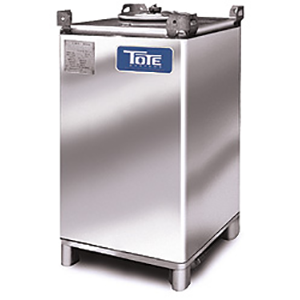
Why stainless over poly for liquids
A caged poly tote is disposable by design. The bottle degrades under UV and repeated use, it can leach into or absorb from the product, and it’s difficult to clean to a validated standard. For bulk water or non-critical fluids, that’s an acceptable trade.
Stainless earns its cost when any of these apply:
- The liquid is corrosive, hot, or under pressure
- You need to clean and reuse the same vessel across batches
- The product is regulated — food, beverage, pharma, nutraceutical
- Cross-contamination between products is a real risk
- You want the container to last years, not trips
A stainless steel liquid IBC tank is built to be cleaned in an automated wash station, inspected, and put back into service. Over a multi-year horizon the cost per use drops well below single-use poly, before you even count the disposal and replacement you avoid.
304 vs. 316 stainless: match the steel to the chemistry
This is the decision people most often get wrong, in both directions.
304 stainless handles the majority of food, beverage, and general industrial liquids. It’s corrosion-resistant, easy to clean, and less expensive.
316 stainless adds molybdenum, which resists chlorides and more aggressive chemistry — think salt, acids, and many pharmaceutical and specialty chemical applications. It costs more, and for a mild product it’s money you don’t need to spend. But put a chloride-bearing liquid in a 304 tank and you invite pitting corrosion that shortens the tank’s life and can contaminate product.
The short version: let the liquid’s chemistry pick the grade, not the price tag. If you’re unsure, share the product’s chemical data and let a manufacturer spec it. TOTE® liquid IBC tanks are available in both 304 and 316 for exactly this reason.
Sizing: capacity is only half the question
Capacity matters, but so does fit with the rest of your operation:
- Footprint — will it fit your fill stations, wash bays, and storage racking?
- Handling — is it rated for forklift and, where needed, stacking?
- Fill and headspace — leave room for thermal expansion with volatile liquids.
If a tank is going to be lifted, tipped, or fed into a line, spec the handling equipment alongside it. Tanks that pair with bin lifts and discharge stations keep the liquid moving without manual pouring or awkward transfers.
Valves, outlets, and discharge connections
For liquids, the discharge end is where day-to-day frustration lives. Consider:
- Valve type and size — butterfly and ball valves each suit different viscosities and flow rates.
- Outlet position and complete drainage — a sloped or dished bottom that drains fully means less residual product left behind, which matters for both yield and cleaning.
- Connection compatibility — the tank’s fittings need to match your pumps, hoses, and discharge or dispensing stations.
Because outlets and fittings are customizable, it’s worth specifying these up front rather than adapting later.
Certifications: know your non-negotiables
Depending on what you’re storing and shipping, some of these are legal requirements, not nice-to-haves:
- UN/DOT for transporting regulated or hazardous liquids by road. TOTE® liquid IBC totes are UN/DOT certified where that applies.
- Sanitary / GMP construction for pharma, nutraceutical, and food — smooth welds, cleanable surfaces, no product traps.
- NSF/ANSI 61 where the liquid is potable-water-related.
Confirm which apply to your product before you buy. Retrofitting a tank to a certification it wasn’t built for usually isn’t possible.
Applications by industry
The same tank serves very different rules depending on where it lives:
- Pharmaceutical & nutraceutical: cleanability and validation drive the spec — often 316, sanitary finish, full drainage.
- Food & beverage: food-contact compliance and easy washdown; 304 is frequently enough.
- Chemical: chemical compatibility and UN/DOT certification lead the decision; grade depends entirely on the product.
Reusable beats disposable on total cost
A single-use poly tote looks cheaper on the invoice. Across a year of turns, a reusable stainless tank you can clean, inspect, and — when needed — refurbish almost always wins on cost per use, and it keeps a stream of plastic out of your waste stream.
Frequently asked questions
Is 304 or 316 stainless better for my liquid?
304 suits most food, beverage, and general industrial liquids. 316 resists chlorides and aggressive chemistry and is common in pharma and specialty chemical work. Match the grade to the product’s chemistry rather than to price.
Do stainless IBC tanks drain completely?
Well-designed tanks use a sloped or dished bottom so liquid drains fully, reducing residual product and making cleaning easier.
Are stainless liquid IBC totes UN/DOT certified?
TOTE® liquid IBC totes are UN/DOT certified where transport of regulated liquids requires it. Confirm the certification matches your specific product and shipping mode.
Can I customize the valves and outlets?
Yes — outlet position, valve type, and fittings can be specified to match your pumps, hoses, and discharge stations.
Ready to spec a tank for your liquid? See full specifications and options on the Liquid IBC Tanks page, or request a quote with your product details and we’ll help you match the grade, valve, and certifications to your process.